Emergency Department Wait Times Are Rising in Canada. Here’s What Healthcare Organizations Can Do About It.
—

Better Information Flow Can Help Improve Patient Flow
Canada’s emergency departments are under increasing pressure.
According to the latest Canadian Institute for Health Information (CIHI) report, highlighted by The Globe and Mail, emergency department wait times continue to rise as hospitals care for an older, more medically complex population.
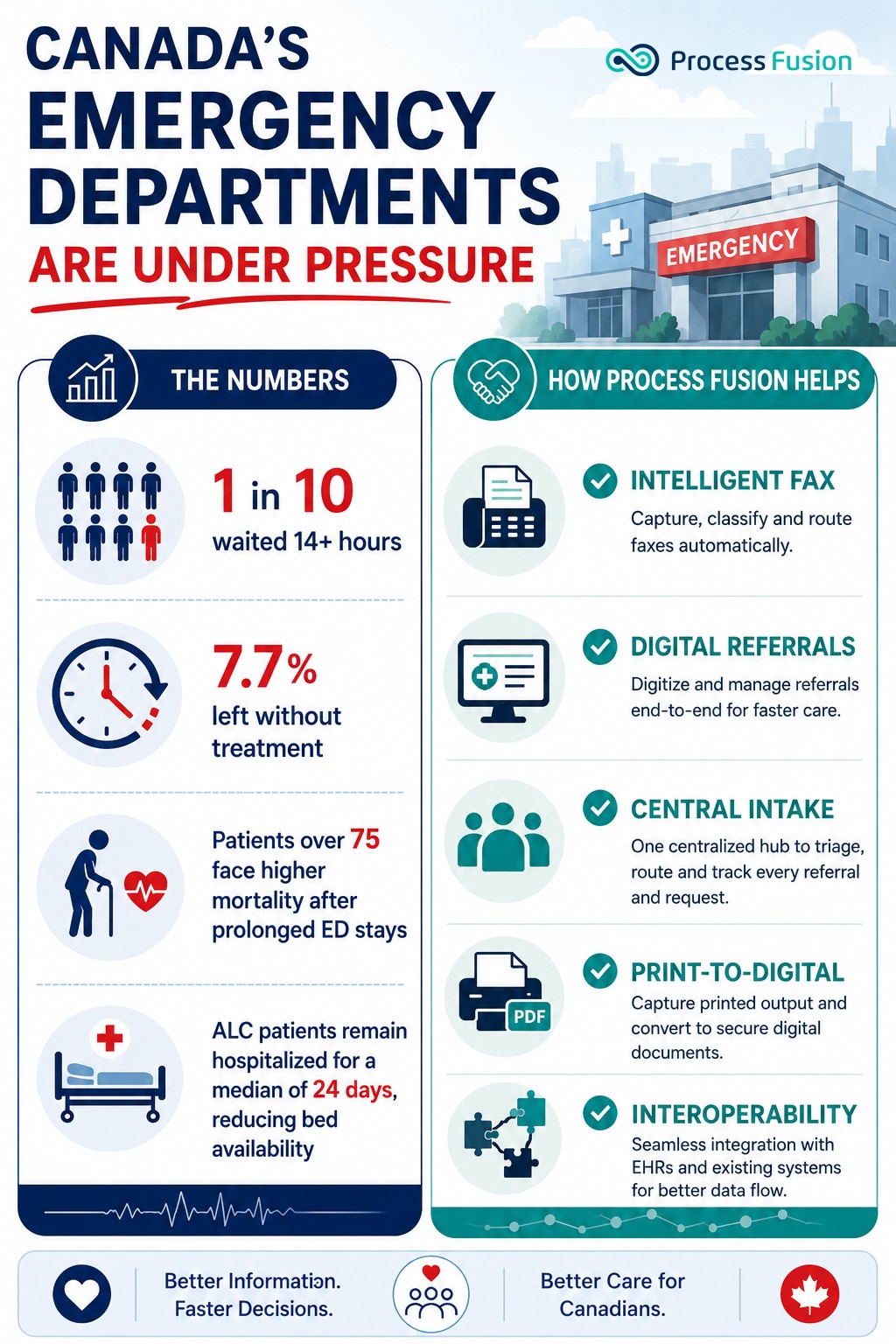
The numbers tell a concerning story:
· 1 in 10 patients waited more than 14 hours in a Canadian emergency department.
· 7.7% of patients left without seeing a physician.
· Patients over 75 years old face significantly higher risks after prolonged emergency department stays.
· Patients designated as Alternative Level of Care (ALC) remained in hospital for a median of 24 days, reducing bed availability for incoming patients.
These statistics reflect a healthcare system under immense pressure—but they also highlight an important truth.
Emergency department congestion isn’t just an emergency department problem.
It’s a healthcare information flow problem.
The Healthcare System Is More Connected Than Ever
One of the most insightful conclusions from the CIHI report is simple:
Everything is interconnected.
Patients don’t begin their healthcare journey in the emergency department.
Their care often starts with:
· Primary care physicians
· Specialists
· Diagnostic imaging
· Community care providers
· Long-term care facilities
· Referral coordinators
Every transition relies on accurate, timely information.
When referrals are delayed, faxes require manual processing, printed reports are misplaced, or healthcare systems don’t communicate effectively, patients experience delays long before they arrive at the emergency department.
These administrative bottlenecks ripple throughout the healthcare system.
Manual Workflows Are Still Slowing Healthcare
Despite significant investments in digital health, many Canadian healthcare organizations still depend on paper-based processes.
Common challenges include:
· Manual fax processing
· Paper referrals
· Printed reports requiring scanning
· Staff manually entering patient information
· Disconnected clinical systems
· Limited visibility into referral status
Each of these tasks consumes valuable administrative time.
More importantly, they delay clinical decision-making.
When healthcare professionals spend time moving documents instead of treating patients, everyone feels the impact.
Better Information Flow Supports Better Patient Flow
Improving patient flow isn’t always about adding more beds or hiring more staff.
Sometimes it’s about removing unnecessary administrative work.
Healthcare organizations that modernize information workflows can:
· Reduce referral processing times
· Eliminate manual data entry
· Improve visibility into patient journeys
· Reduce lost or delayed documentation
· Accelerate communication between departments
· Free clinical and administrative staff to focus on patient care
Small improvements in workflow efficiency, repeated thousands of times every day, create meaningful operational gains.
How Process Fusion Helps
At Process Fusion, we help healthcare organizations modernize the way information moves throughout their existing healthcare ecosystem.
Our solutions are designed to work with your current technology investments—not replace them.
Intelligent Fax
Automatically receive, classify, extract, and route inbound clinical documents to the appropriate teams. No manual sorting. No lost referrals. No unnecessary delays.
Digital Referrals and Central Intake
Automate referral intake from multiple sources while providing visibility into every referral’s status. Clinical teams spend less time searching for paperwork and more time coordinating patient care.
Print-to-Digital
Process Fusion captures those printed reports and documents automatically, converts them into secure digital files, and routes them to the appropriate repository or workflow.
This reduces dependency on physical printers while improving document accessibility and continuity of care.
Interoperability
Healthcare organizations operate dozens of applications across multiple departments.
Process Fusion helps connect these systems so critical patient information flows securely between them.
Digital Transformation Doesn’t Have to Mean Replacing Existing Systems
Healthcare organizations have already invested heavily in their EMRs, diagnostic systems, imaging platforms, and clinical applications.
The goal isn’t to replace these investments. The goal is to make them work together.
By improving interoperability and automating document-intensive workflows, hospitals can remove unnecessary friction from everyday operations while supporting clinicians with faster access to the information they need.
Ready to Improve Information Flow?
Whether you’re modernizing referrals, digitizing paper-based workflows, implementing intelligent fax automation, or connecting healthcare systems through interoperability, Process Fusion helps healthcare organizations streamline operations without replacing the systems they already rely on.


LIFE AT PROCESS FUSION
Team activities that turn colleagues into community
From social gatherings and shared celebrations to collaborative activities, we create space for people to connect beyond projects. These moments strengthen relationships, spark new ideas, and make everyday teamwork more meaningful.
01
Pride
We take pride in the work we create, the customers we support, and the positive impact we make together. Every contribution matters, and shared ownership turns good work into meaningful progress.
02
Trust
Open communication, respect, and accountability give people the confidence to contribute fully. We trust one another to share ideas honestly, follow through, and grow from every challenge.
03
Camaraderie
Shared experiences, team activities, and everyday support create genuine connection. We make room to laugh, celebrate, and help one another—building a community where people feel they belong.