
The Problem: Fragmented data causes 70% of digital transformation projects to stall or fail.
The Solution: A unified Interoperability Engine that bridges the gap between document intake (AP/Capture) and output (Print/Cloud Storage).
The Result: A secure, serverless, and vendor-neutral infrastructure provided by a cloud services provider that connects legacy hardware with modern cloud ERPs, ensuring end-to-end automation.
I. What is an Interoperability Engine in Digital Transformation?
Digital transformation is not merely about adopting new technologies; it’s about seamlessly connecting them. A significant barrier, however, arises when critical data and documents become trapped in isolated systems – an invoice in an email that needs to integrate with an ERP(Enterprise Resource Planning), or a patient record in a DMS(Document management System) that requires secure printing. This fragmentation is precisely where an Interoperability Engine becomes indispensable.
An interoperability engine is a vendor-neutral, cloud-native architectural framework designed to standardize and automate how data moves between disparate enterprise systems. Unlike simple point-to-point integrations, it establishes a central, intelligent hub. This hub provides a single logic layer for both Document Automation (the intake and processing of information) and Enterprise Output (the secure distribution and printing of that information), effectively eliminating the data silos that plague modern organizations.
The core value of such an engine lies in its ability to manage permissions, enforce security policies (like Zero Trust), and validate data consistently across an entire fleet of enterprise tools. It ensures that every piece of information flows effortlessly from its source to its ultimate destination, enabling genuine end-to-end automation.
II. Interoperability Engine vs. Traditional Middleware: A Fundamental Difference
Many organizations believe they achieve digital transformation through various integrations. However, there is a crucial distinction between simple integration and comprehensive interoperability. Traditional middleware often creates complex, fragile point-to-point connections – akin to a “spaghetti code” network. Each new application requires a custom API, leading to escalating maintenance costs and limited scalability. This patchwork approach results in “islands of automation” that, while solving individual problems, fail to address the overarching challenge of enterprise-wide data fluidity. When software systems lack interoperability, organizations face inefficiencies due to incompatible data formats, APIs, and standards, making data sharing and process support more difficult.
An Interoperability Engine, such as the framework underpinning the Process Fusion 360 platform, operates on a fundamentally different principle: a central “hub-and-spoke” model. Here, data is ingested, validated once, and then intelligently distributed to all relevant systems and endpoints. This unified approach eliminates redundant data entry, reduces security vulnerabilities (like those seen in “PrintNightmare” scenarios), and provides a consistent, transparent view of document workflows across the entire organization.
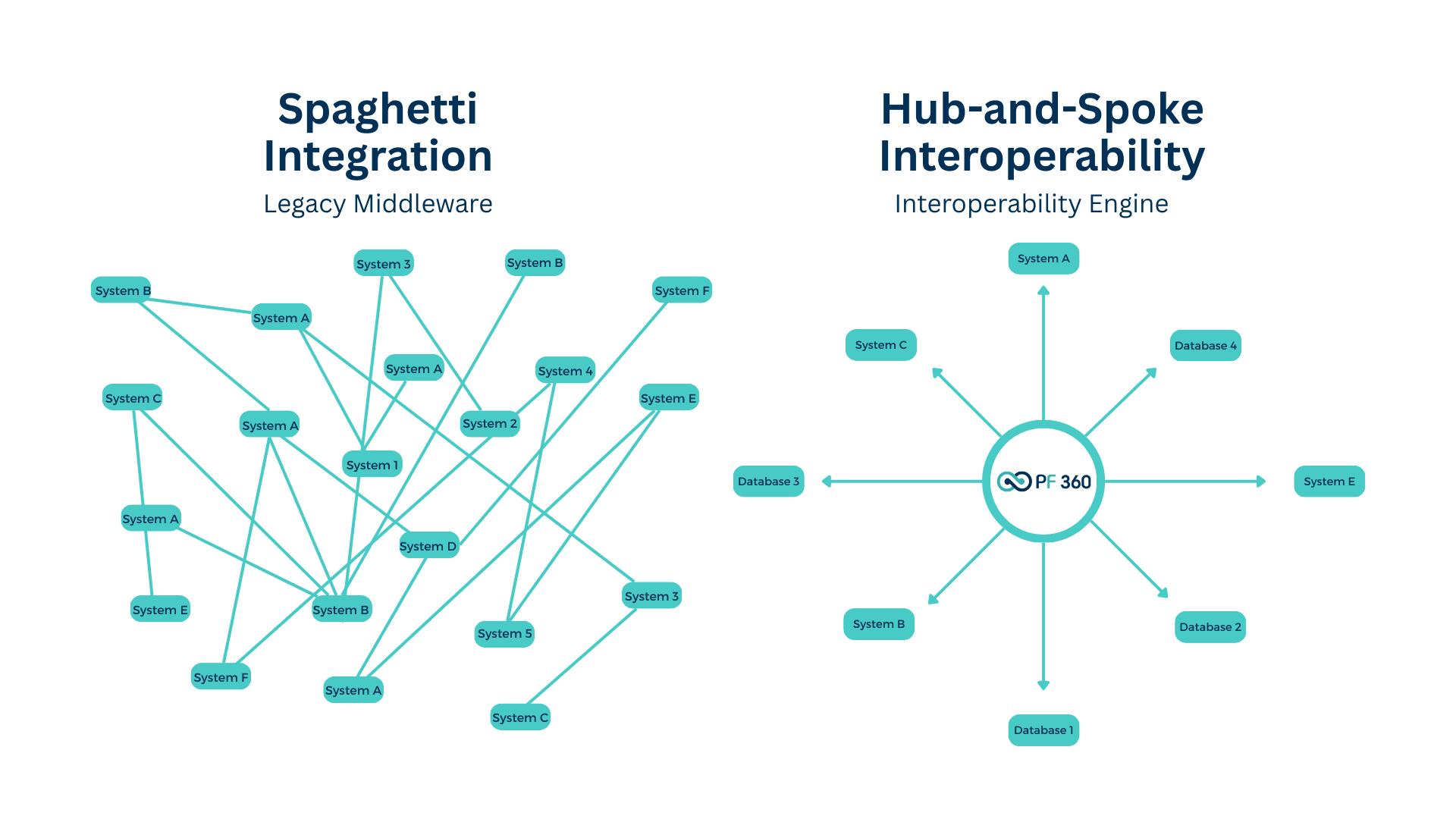
Feature | Legacy Middleware Approach | PF 360 Interoperability Engine |
Architectural Style | Point-to-point (Fragile, custom code) | Centralized Hub (Scalable, unified logic) |
System Synchronization | Manual API coding per application | Out-of-the-box native connectors |
Data Movement | Siloed (Capture often separate from Print) | Unified (End-to-end document lifecycle) |
Maintenance Burden | High (Local servers, complex APIs) | Low (Cloud-native, serverless) |
Security & Compliance | Patchwork policies per application | Unified Zero Trust & Secure Release |
Flexibility | Hard-coded, difficult to modify | Open API, highly extensible |
III. Achieving Data Liquidity: Standardizing Document Intake with AI
The initial phase of digital transformation is often the most challenging: converting unstructured information into actionable data. An Interoperability Engine excels at this “intake layer,” driving document and AP automation beyond mere scanning. It’s about achieving data liquidity – ensuring information flows freely from its entry point into the systems that need it.
This process leverages AI-Driven Extraction to automatically read, classify, and extract key information from diverse document types – be they physical invoices, faxes, digital PDFs, or medical records. This advanced AI goes beyond basic OCR (Optical Character Recognition), understanding context and nuances to transform unstructured content into structured, validated data.
Syntactic interoperability allows two systems to communicate with each other using common data formats and communication protocols, such as such as XML or JSON.
Once validated, this critical data must be bi-directionally synced with core business applications, eliminating manual data entry and speeding up critical processes.
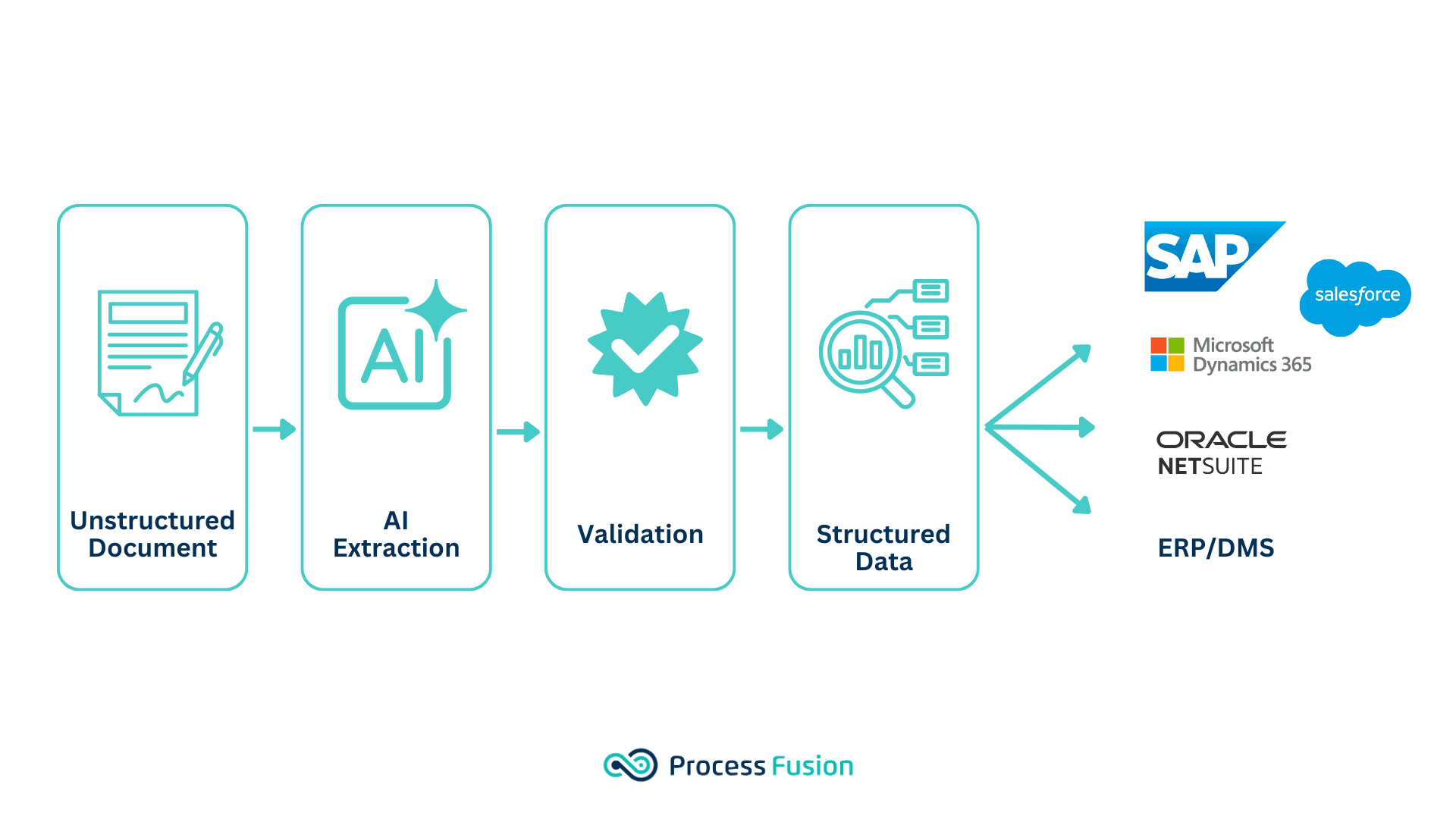
Enterprise Integration Matrix: Connecting Your Critical Systems
An effective Interoperability Engine offers robust, pre-built connections to a broad spectrum of enterprise platforms, ensuring seamless data flow across your entire organization.
Category | Supported Platforms |
ERP & Financial Management | SAP, Oracle, NetSuite, Sage, QuickBooks, JDEdwards, Microsoft Dynamics (AX, GP, 365), IFS, Advantage SMB |
Content & Document Management | Microsoft Syntex, SharePoint, Laserfiche, DocuShare (On-Prem/Flex), OneDrive, Snowflake |
Healthcare Specific | EPIC, OceanMD, PointClickCare |
Construction & Industry | CMiC, Genius ERP |
Collaboration & Communication | Microsoft Outlook |
This extensive integration capability highlights how an Interoperability Engine serves as a central hub, making your disparate systems truly work as one.
IV. The Transition to Serverless Print Infrastructure: Secure Data Distribution
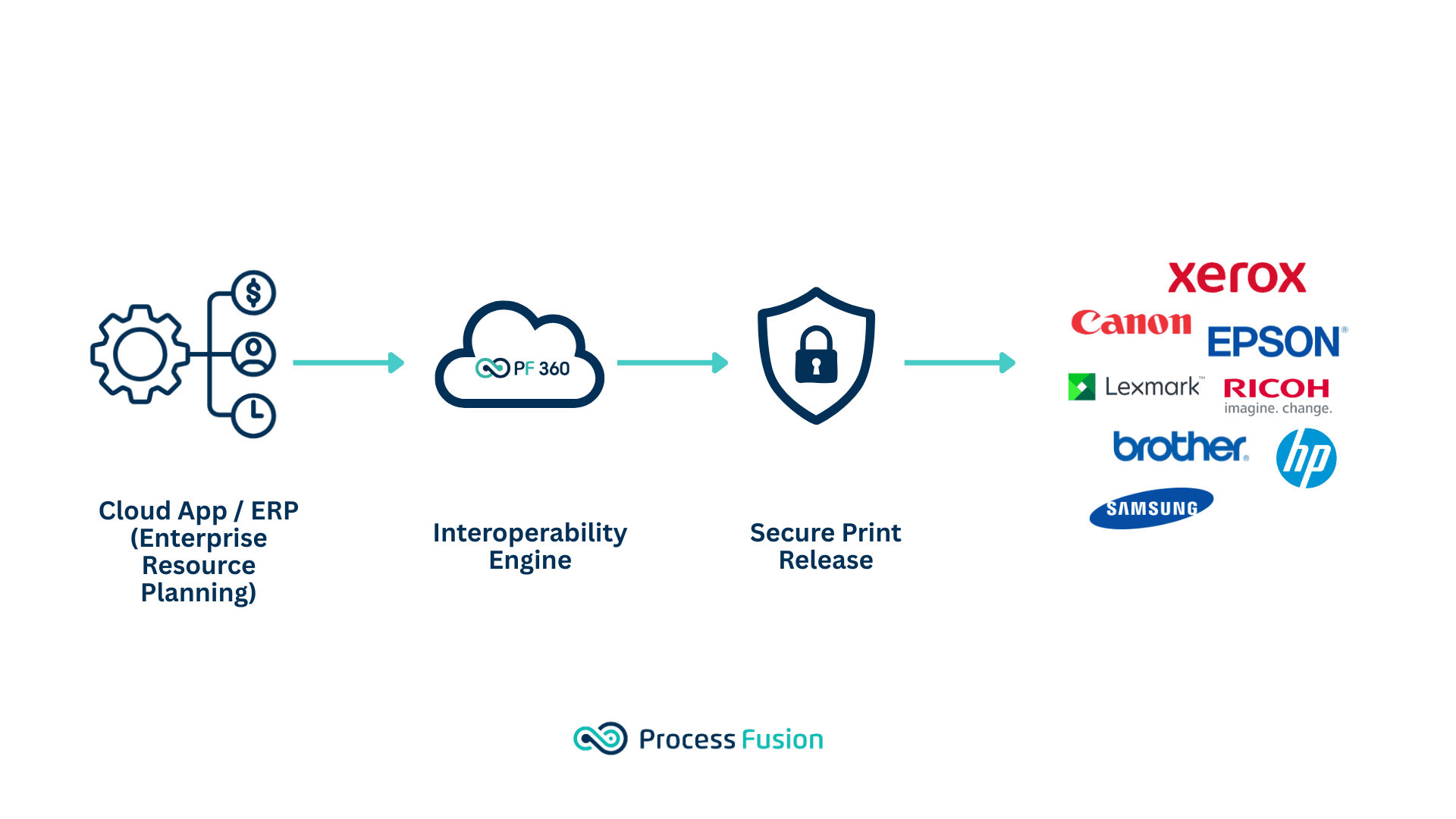
The other side of the digital transformation coin is the intelligent distribution and output of information. Historically, this has been managed by local print servers – costly, maintenance-heavy silos that often fail to integrate seamlessly with modern cloud applications. An Interoperability Engine revolutionizes this by introducing a serverless print infrastructure.
This evolution moves the entire print and document distribution logic to a cloud-native engine. It fundamentally changes how organizations manage their document output, offering significant advantages:
Manufacturer Neutrality: The engine abstracts the hardware layer, meaning a single, universal driver can manage a mixed fleet of devices from manufacturers like HP, Ricoh, and Xerox. This simplifies IT management and reduces compatibility headaches.
Seamless Cloud Integration: Documents generated or stored within cloud platforms (e.g., OneDrive, Google Drive, Dropbox) can be seamlessly and securely directed to any authorized output device, or routed back into an ECM system like SharePoint.
Security as a Standard: At the heart of this output layer is a robust security framework. Secure Pull-Printing is a key component of a Zero Trust architecture: print jobs are held in a secure cloud queue and are only released when the authorized user authenticates directly at the physical printer, preventing sensitive information from being left unattended.
Legacy System Compatibility: Despite its cloud-native design, an effective Interoperability Engine also provides mechanisms, often through Open APIs, to enable legacy on-premise applications to leverage these modern, secure cloud-managed print environments.
V. Scaling Interoperability for Enterprises and Managed Service Providers (MSPs)
The inherent design of an Interoperability Engine lends itself perfectly to scalability and centralized management, making it an invaluable asset for large enterprises with complex structures or Managed Service Providers (MSPs) supporting multiple clients.
This architecture enables a multi-tenant model, which means a single instance of the platform can securely manage and isolate the data and workflows of numerous distinct “tenants” (e.g., different departments, subsidiaries, or client organizations).
For MSPs, this translates to an “Interoperability-as-a-Service” model. They can offer advanced document automation and secure cloud printing capabilities to their entire client base from a single, unified administrative dashboard. This allows for:
Centralized Administration: Global policy updates, security protocols, and integration configurations can be managed from one location, drastically reducing operational overhead.
Consistent Service Delivery: Ensuring all tenants benefit from the same high standards of automation, security, and uptime.
Rapid Onboarding: New clients or departments can be quickly integrated into the existing framework without extensive custom development.
This strategic capability positions the Interoperability Engine as a powerful platform, not merely a point solution, driving efficiency and security across diverse and complex organizational landscapes.
VI. Entity-Rich FAQ (Knowledge Graph Optimization)
Does an interoperability engine replace my existing ERP system?
No, an interoperability engine does not replace your ERP (Enterprise Resource Planning) system. Instead, it acts as a powerful accelerator, a bridge that ensures your ERP (such as SAP, Oracle, or Microsoft Dynamics) receives high-quality, validated data without manual intervention, maximizing your investment in these core systems.
Can Process Fusion 360 integrate with Microsoft Syntex and SharePoint for document management?
Yes, Process Fusion 360 serves as a primary bridge. It is designed to extract data from various physical or digital sources and push structured content into Microsoft Syntex for advanced AI-driven document processing, as well as seamlessly integrate with SharePoint for comprehensive document management and collaboration.
Is serverless printing compatible with legacy Line-of-Business (LOB) applications?
Absolutely. While serverless printing is cloud-native, a robust interoperability engine facilitates connectivity with legacy on-premise applications. Through an Open API, the engine allows these traditional LOB applications to securely output to and leverage modern cloud-managed print environments, extending their lifespan and enhancing their capabilities.
How does an Interoperability Engine enhance data security?
An Interoperability Engine enhances data security by providing a unified security layer. This includes features like Zero Trust secure pull-printing, centralized access controls, and consistent data validation policies across all integrated systems, minimizing vulnerabilities inherent in fragmented architectures.


