Secure Document Lifecycle Management in Healthcare & Finance
—

Artificial Intelligence (AI) and Machine Learning (ML) are transforming operations, but in highly regulated sectors like healthcare and financial services, integrating these technologies into document processing and print management introduces complex security and compliance challenges. Data breaches or biased algorithms can lead to severe penalties and eroded trust.
This Master Guide provides a structured framework for Secure Document Lifecycle Management, outlining foundational principles, critical regulatory frameworks, and practical implementation strategies. It ensures the AI-powered automation you implement upholds the highest standards of data integrity, privacy, and auditability, transforming risks into opportunities for enhanced security and compliance.
What defines a secure document lifecycle in regulated industries?
A secure document lifecycle is characterized by end-to-end protection, from creation and capture to processing, storage, and disposition. It integrates robust security controls, adheres to stringent data privacy regulations, ensures transparent and auditable workflows, and maintains continuous human oversight. This holistic approach is essential for meeting compliance mandates such as HIPAA, SOC 2, ISO 27001, and the EU AI Act.
The Imperative: Why Secure Document Lifecycle Management is Critical
In regulated industries, documents are critical assets. AI-driven document automation, such as AI-powered OCR for invoice capture, introduces new risks. Each stage of the document journey—from digital capture to physical output—presents potential vulnerabilities.
Inadequate document security leads to severe financial and reputational consequences, with healthcare data breaches exceeding $10 million per incident. A proactive, comprehensive approach to securing the entire document lifecycle is a fundamental business imperative.
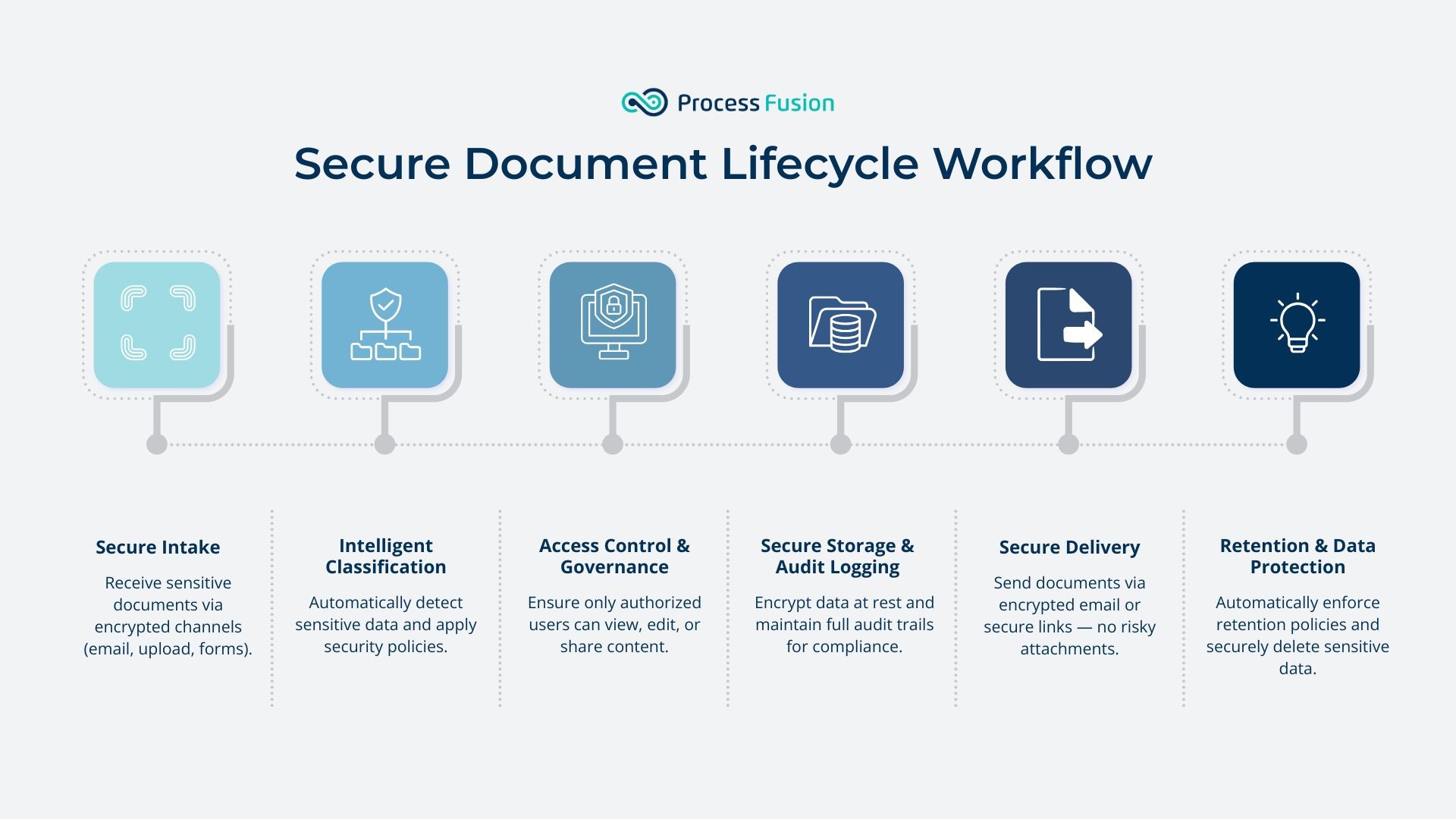
Key Frameworks for Document & Print Automation
Document and print automation must navigate a complex web of sector-specific laws and data protection regulations. Understanding these frameworks is crucial for a robust compliance strategy.
Framework | Primary Industry Focus | Core Mandate for Document & Print Automation |
HIPAA / HITECH | Healthcare | Protects PHI; mandates secure electronic transmission, storage, and processing of health records, including BAAs with vendors. |
SOC 2 (Type II) | Service Organizations | Evaluates the effectiveness of controls related to Security, Availability, Processing Integrity, Confidentiality, and Privacy. |
ISO 27001 | Global (Information Security) | Specifies requirements for establishing and maintaining an Information Security Management System (ISMS). |
The Five-Pillar Trust & Security Framework for Document Lifecycle Management
This five-pillar framework provides a robust, actionable model for organizations to assess and advance their security posture in document lifecycle management. Organizations can use this framework to benchmark their current capabilities and identify areas for enhancement, moving from foundational compliance to advanced, proactive security measures.
Pillar 1: Comprehensive Governance & Risk Management
Effective governance is foundational. An Automation Governance Committee and the NIST AI Risk Management Framework (AI RMF) systematically identify, assess, and mitigate risks in automated data extraction and routing. This commitment to governance is often exemplified by organizations that implement formal Information Security Management Systems (ISMS), certified to standards like ISO 27001 .
Pillar 2: Data Privacy & Protection by Design
Privacy by Design mandates data protection from the outset. This includes Least Privilege, Data Minimization, End-to-End Encryption, and Secure Print Release. A Zero Trust Architecture (ZTA) provides continuous verification. Adherence to standards like ISO 27017 (cloud security) and ISO 27018 (PII protection in clouds) is crucial, alongside prioritizing data residency and comprehensive encryption .
Pillar 3: Secure Infrastructure & Supply Chain
Security requires a Secure Development Lifecycle (SDLC) and rigorous Third-Party Vendor Security Evaluation, including BAAs for PHI and SOC 2 Type II reports. Migrating to secure, serverless cloud printing solutions eliminates the vulnerabilities of traditional print servers. Reputable providers demonstrate their commitment through regular SOC 2 Type 2 audits.
Pillar 4: Transparency, Explainability & Auditability
Transparency is a legal imperative. Organizations must explain AI decisions using Explainable AI (XAI) techniques. Immutable Audit Trails log every significant event to comply with regulations such as SR 11-7 and HIPAA. Making auditability central, with every processed document and workflow step generating an immutable audit trail, is essential for ASME Governance and financial regulatory compliance.
Pillar 5: Human Oversight & Continuous Monitoring
Meaningful Human Oversight and Continuous Monitoring are vital as data and regulations evolve. Human-in-the-Loop (HITL) Design ensures AI acts as a decision-support tool. Intelligent Capture solutions often include HITL capabilities, routing low-confidence AI extractions to human experts for validation, thereby ensuring accuracy and compliance.
Operationalizing the Blueprint with Trusted Partners
While this blueprint outlines the essential pillars for secure document lifecycle management, its successful implementation often relies on strategic partnerships. Providers like Process Fusion demonstrate a commitment to these principles by adhering to rigorous security standards. Process Fusion is committed to achieving the highest security standards with the proper controls, as defined by industry standards and frameworks on an ongoing basis.
How Process Fusion Build Your Secure Automation Roadmap Strategically
Priority | Action Item | Pillar | Process Fusion Alignment |
Critical | Conduct AI system inventory and risk classification | Governance | Supported by ISMS, ISO 27001 |
Critical | Execute BAAs with all AI vendors handling PHI | Data Privacy | Process Fusion provides BAAs |
Critical | Implement end-to-end encryption for all AI data pipelines | Data Privacy | End-to-end encryption, ISO 27017/27018 |
Critical | Establish immutable audit logging for all AI system events | Auditability | PF 360 Capture/Print audit logs |
High | Deploy Zero Trust access controls for AI data environments | Data Privacy | Robust access controls, data residency |
High | Conduct an AI-specific threat model for each deployed system | Infrastructure | UK Cyber Essentials, SOC 2 Type 2 |
High | Implement bias testing and fairness audits on a quarterly basis | Auditability | Human-in-the-Loop validation |
Medium | Achieve SOC 2 Type II certification (or require it from vendors) | Infrastructure | Process Fusion is SOC 2 Type 2 certified |


LIFE AT PROCESS FUSION
Team activities that turn colleagues into community
From social gatherings and shared celebrations to collaborative activities, we create space for people to connect beyond projects. These moments strengthen relationships, spark new ideas, and make everyday teamwork more meaningful.
01
Pride
We take pride in the work we create, the customers we support, and the positive impact we make together. Every contribution matters, and shared ownership turns good work into meaningful progress.
02
Trust
Open communication, respect, and accountability give people the confidence to contribute fully. We trust one another to share ideas honestly, follow through, and grow from every challenge.
03
Camaraderie
Shared experiences, team activities, and everyday support create genuine connection. We make room to laugh, celebrate, and help one another—building a community where people feel they belong.


